Drafts
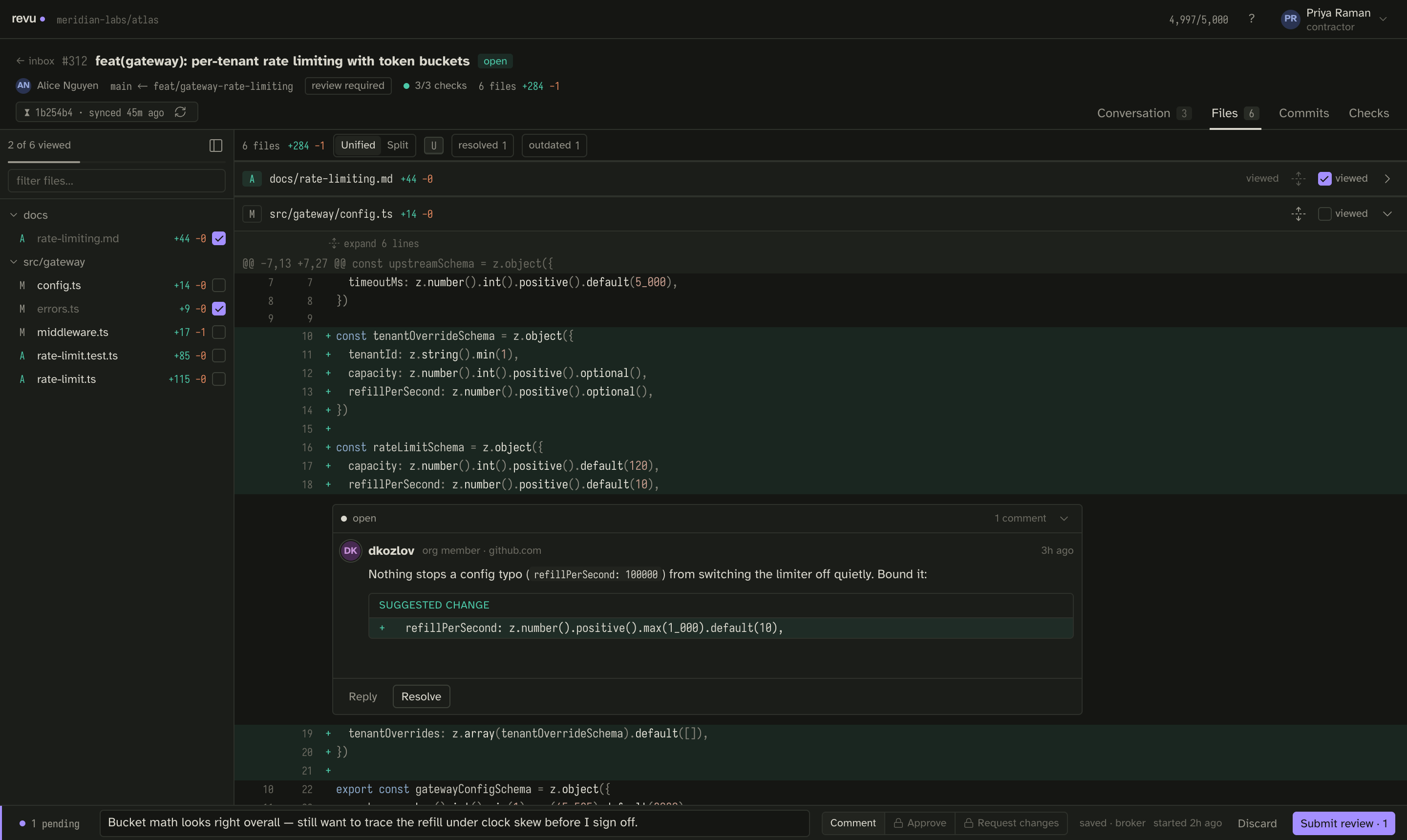
The local review draft — saved as you type, keyed to the human, and durable across a restart until submit succeeds.
Your review in revu is a local draft, not a server-side pending review. As you write inline comments and a review summary, the draft is saved to a durable local store — and it stays there, keyed to you, until you submit it successfully. A restart loses nothing. This is the app's whole thesis rendered as behavior: the draft is the work GitHub cannot see, and the design gives it the one loud color — violet — reserved for exactly that.
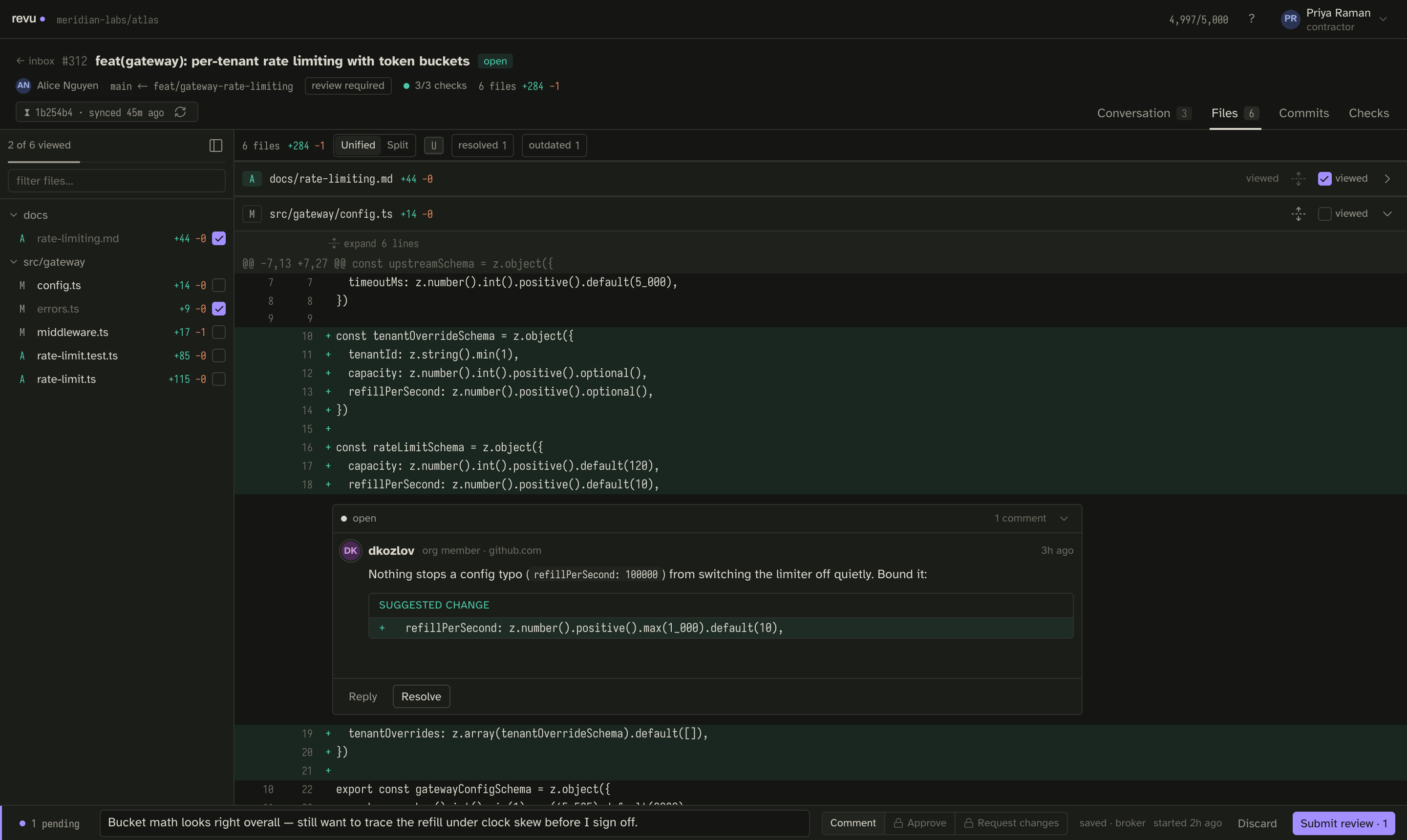
Saved as you type
The draft is written to disk automatically while you type — debounced at 600ms, with an immediate flush when the browser tab is hidden. You do not save a draft; it is always already saved. There is exactly one honest limit here, and the tool states it plainly: a hard crash inside the debounce window can lose up to the last 600ms of typing. Everything flushed before that survives.
Keyed to the human, durable across a restart
Drafts persist in a local SQLite store, keyed by the human — specifically the lowercased git-config email, the same stable identity key used for viewed state. In direct mode that store lives under the durable data directory:
${XDG_DATA_HOME:-~/.local/share}/revuOverride it with REVU_DATA_DIR. Because the draft is keyed to the human and written to a
durable store rather than localStorage, closing the tab, restarting the daemon, or coming
back tomorrow all recover the exact draft you left. The UI treats that persistence as quietly
load-bearing — you are meant to trust it enough to stop thinking about it.
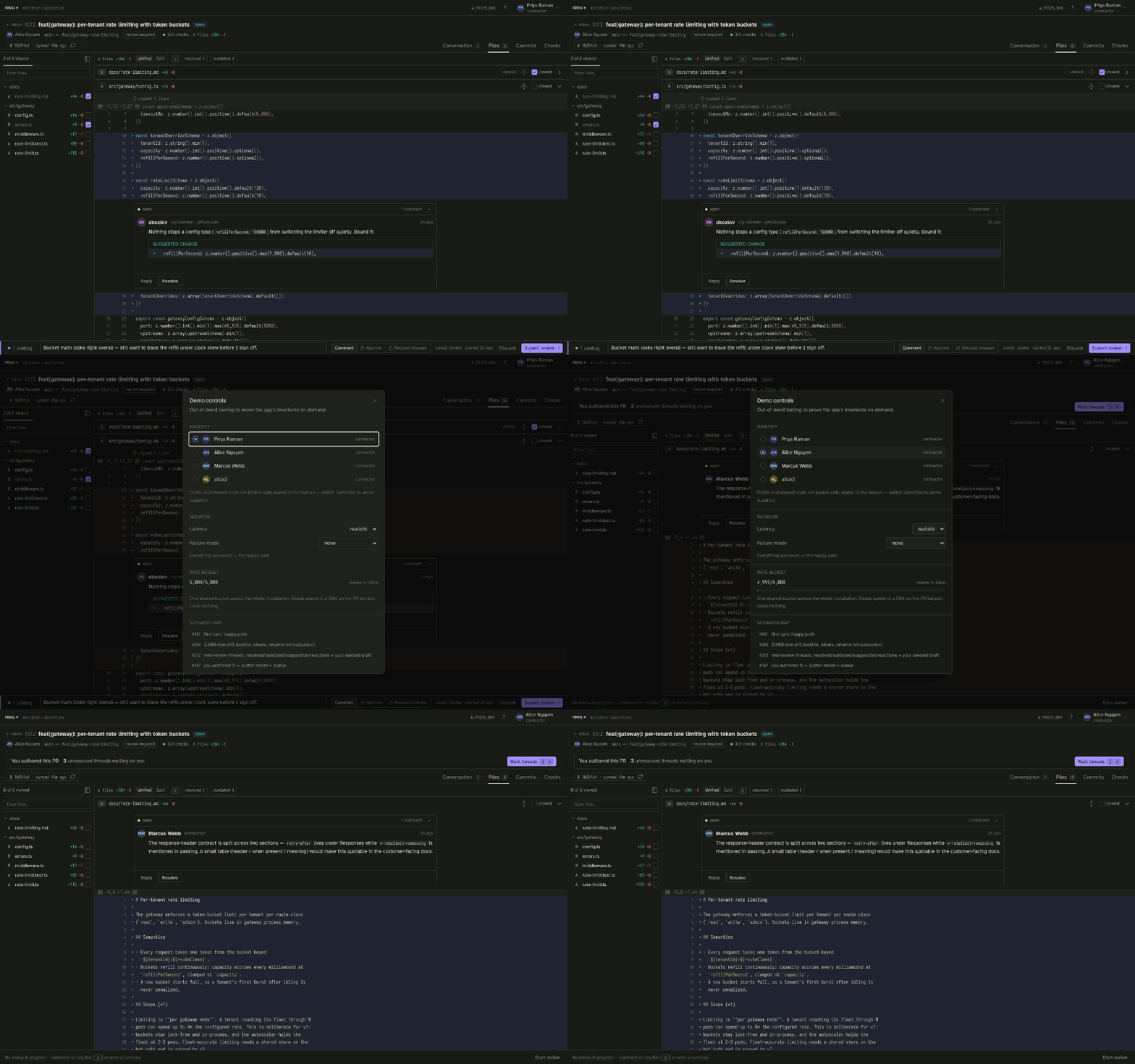
Keyed to the human means isolated between humans: one person's pending draft is not another's. Switching the active identity swaps the whole review rail — the pending comment that belonged to the first human simply is not there for the second.
Deleted only on confirmed submit success
The invariant that makes all of this safe: a draft is deleted from disk only on confirmed submit success. Nothing else removes it.
- You submit; GitHub accepts the review; the draft is deleted and the created review is returned.
- You submit, but the branch moved between your last sync and the submit — GitHub reports the head moved. The draft is kept intact so you can re-sync and route through reconcile.
- A comment fails server-side validation after the head guard passed (a force-push in the narrow window between guard and post) — the draft is not deleted; the conflict surfaces and the draft survives to be reconciled and resubmitted.
The draft survives everything until it lands. You submit a draft as one of three reviews — Comment, Approve, or Request changes — from the review bar; Comment is the primary action, and Approve is gated to where it actually works (see identity).