Snapshot
A PR pulled down in one sync burst — diff, files, threads, commits, checks — then reviewed fully locally.
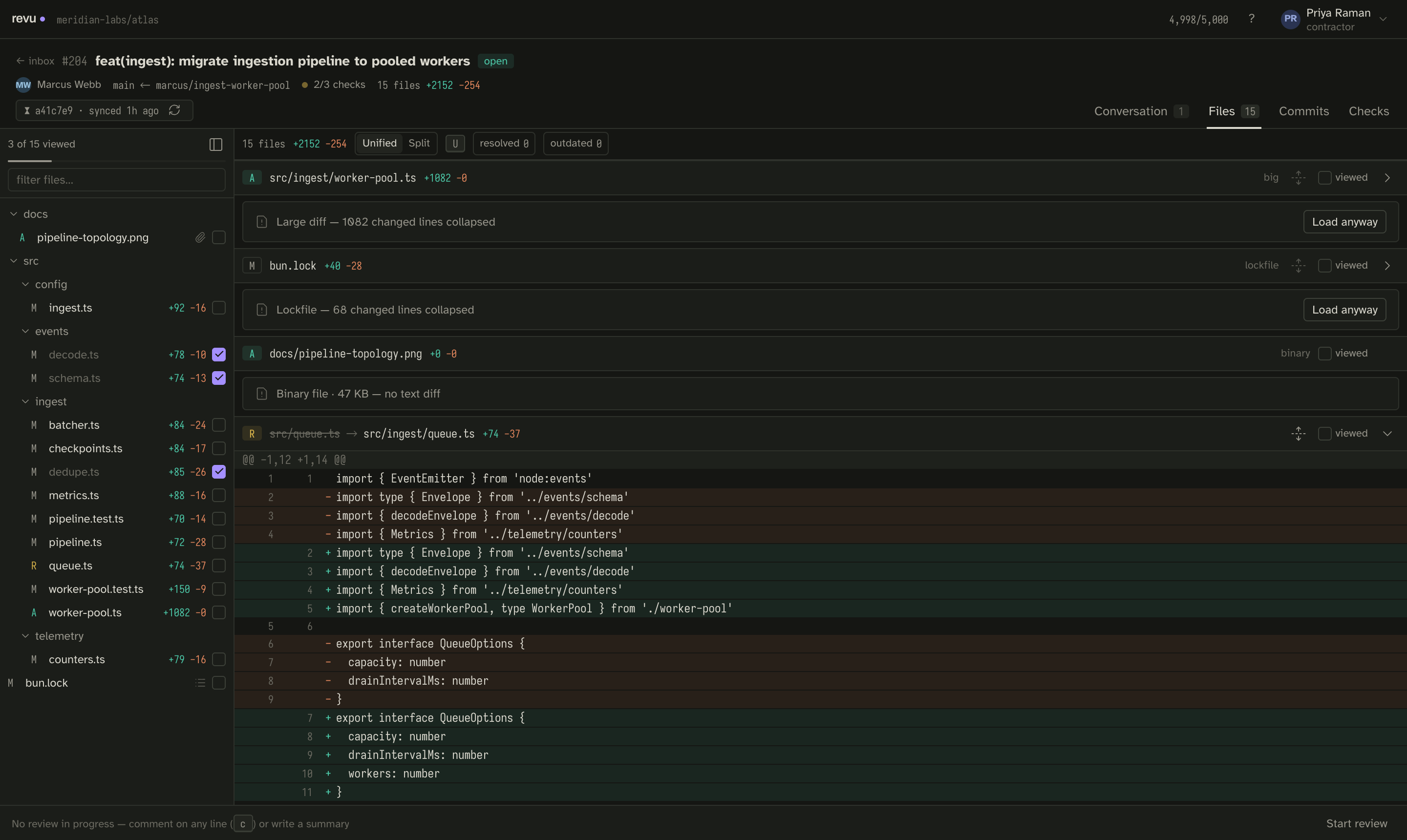
A pull request in revu is a snapshot: one sync burst pulls everything you need to review — the diff, files, review threads, commits, and check runs — down from GitHub, and after that the whole review works with the network gone. Expanding context, reading threads, jumping between files, and writing inline comments are all local operations against the snapshot in your durable store. The network is spent once, on purpose. That is what the rate budget buys, and it is why review keeps working when the connection is flaky.
What a sync pulls
A cold sync of a PR is a bounded burst of GitHub REST and GraphQL calls — the PR detail and merge base, the changed files with their patches, the review threads with their comments and resolved/outdated state, the issue comments, reviews, commits, and the head commit's check runs. Blobs are the one thing a sync tries hard not to fetch: they come from your local git object store instead (see compare key).
The snapshot has two halves that are refetched on different schedules:
| Half | Contents | Refetched |
|---|---|---|
| Immutable | The diff, file patches, and blobs for this merge_base...head | Only when the compare key changes |
| Mutable | Threads, checks, mergeability, review state | Every sync, unconditionally |
Because the mutable half is always refetched, a thread someone resolved elsewhere — with zero new commits — still shows up after a re-sync. Nothing about a stale head lets revu skip the mutable fetch.
The snapshot seal
Every PR header carries a snapshot seal — the offline-first contract made visible. It stamps, in mono, the head SHA it synced and how long ago. The seal is the answer to the question every offline review tool has to answer honestly: how old is what I am looking at?
The seal has two states:
- Fresh — quiet and structural. A hairline-bordered mono stamp; nothing is asking for your attention because nothing changed.
- Stale (gold) — the world moved under you since you synced. The seal turns gold and grows a re-sync action, and it names what moved in words, never color alone — for example, new commits since your sync, or a base branch that advanced. Staleness is always glyph plus text, so it reads for someone who can't see the color at all.
Gold is reserved across the whole app for one meaning: time moved under you. When the seal is gold, re-syncing pulls a fresh snapshot. If you have a pending draft against the old head, submitting or re-syncing routes you through reconcile rather than throwing your work away.
Partial snapshots
A sync can die partway — the connection drops mid-burst. When that happens revu keeps the partial snapshot it did manage to fetch and names what is missing, rather than discarding the whole thing and starting over. A retry fetches only the missing pieces. A never-synced PR has no snapshot at all, which the tool represents as an explicit empty state, not an error.
Related
- Compare key — how the immutable half is keyed and shared.
- Rate budget — why the burst-then-local shape exists.
- Reconcile — what happens to a draft when the seal goes gold.