Architecture
One RevuApi contract, one shared core in revud, and mode strategies plugged in around it — mock, direct, and broker.
revu has one architectural rule that everything else follows from: the UI reads and writes through exactly one interface, and a run mode is a small pair of strategies plugged in around one shared core. The core is never forked per mode.
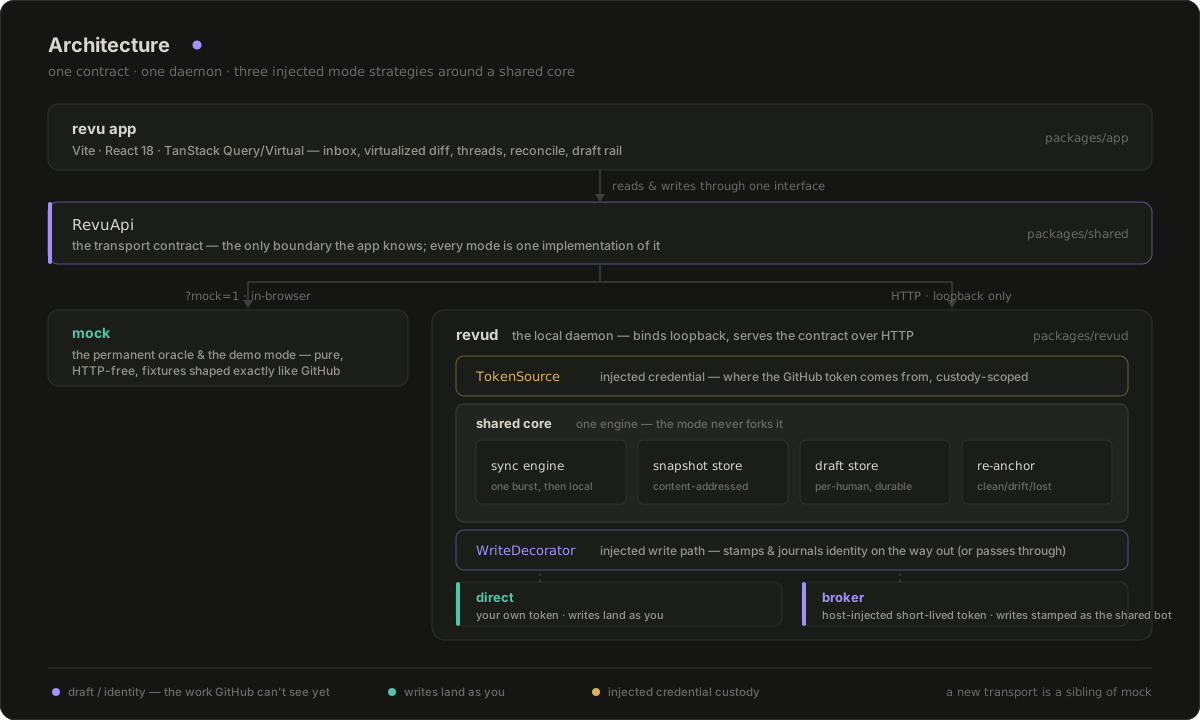
The one boundary
The React frontend talks to exactly one interface — RevuApi
(packages/shared/src/api/client.ts). It is the sole boundary between the UI and
any transport. The app never imports a GitHub client, never holds a token, and
never branches on which mode it is running in; it calls syncPull, getDraft,
submitReview and the rest, and something on the other side of the interface
honors them.
Two things bind that interface at runtime:
- In the browser, it binds an in-process mock adapter backed by fixtures. No daemon, no token, no network.
- Over HTTP, it reaches
revud— a single Bun daemon that serves the built app as static files and the API under/api/, on one loopback port (default4780). One port, no CORS.
Because the app depends only on the contract, adding a real transport is a sibling of the mock and nothing else in the UI changes.
revud: one shared core, two injected strategies
Inside revud, one shared core does the actual work — the sync engine, the
snapshot store, the draft store, and the re-anchor (reconcile) logic. That core
is almost all of the code. Wrapped around it are two small injected strategies
that are the only thing a run mode changes:
TokenSource— where the GitHub token comes from. In direct mode it is theghcredential chain (GH_TOKEN→GITHUB_TOKEN→gh auth token); in the reserved broker design it reads a host-injected credential file fresh on every request.WriteDecorator— how identity is stamped and journaled on the way out, if at all. In direct mode it is a passthrough: comments post as the realghuser, unstamped. In the reserved broker design it prepends the author's name and appends an audit-log row per write.
A run mode is precisely that pair of strategies plugged in around the core. The
core does not know which mode it is in; it asks the TokenSource for a token and
hands each write to the WriteDecorator. This is why direct mode and the broker
design share one sync engine, one snapshot store, one draft model, one reconcile
scorer — and therefore one set of bugs to fix rather than three.
The three modes as strategy pairs
| Mode | TokenSource | WriteDecorator | Status |
|---|---|---|---|
| Mock | none — fixtures, in-process | none — the mock store is the write | Shipped |
| Direct | gh credential chain | passthrough (posts as the real user) | Shipped |
| Broker | host-injected credential file | stamp author name + append audit row | Reserved |
Broker mode is reserved — not a shipped boot option
Broker mode is designed and documented, but it is not yet a shipped, runnable boot option. Only mock and direct modes boot today. The broker strategy pair, the host collector, and the audit journal are described so they can be reasoned about and built against — see Broker mode — not as something you can rely on running in a released build.
Why a daemon at all
The browser cannot do three things the contract needs, and all three apply in every real mode:
- The token never enters the browser. It lives in
revud, is never logged, and is never sent to the client. - The snapshot cache and draft store need somewhere durable that is not
localStorage— a SQLite file that survives a restart, and, in the broker design, a workspace rebuild. - Blob reads can come from the local git clone. After
git fetch, the base and head blobs a snapshot needs are usually already on disk, agit cat-fileaway — zero API requests. A browser cannot read your git object store;revudcan. This is what keeps a large-PR sync cheap. See the rate budget and compare key.
The mock is the oracle, not a stub
The mock is not scaffolding to be deleted once a real transport exists. It is permanent, and it is load-bearing in two ways:
revud's own mock mode reuses the app's mock adapter over HTTP. The same fixtures the browser demo runs against are served by the daemon, which is how the transport seam is proven with zero GitHub risk — the UI cannot tell the difference, which is the point.- A cross-transport conformance suite holds every adapter to the identical
contract. The suite (
packages/shared/conformance) is parameterized over anyRevuApiimplementation and asserts the contract's hard invariants once, then runs them against the in-process mock and against the daemon over HTTP. The assertions are the property of the contract, so they live in the shared package, not in any one transport.
The invariants the suite pins down are exactly the ones that look like failures but are not:
submitReviewreturnshead_movedas a 200-level value and never throws for it, so the UI can route into reconcile instead of failing.syncPullthat dies mid-transfer keeps a partial snapshot (surfacing the drop as anetworkerror) and the retry completes withpartial: null, fetching only the missing blobs.getSnapshotanswersnull— never a thrown 404 — for a pull that was never synced.
Every adapter must uphold all three. See Types & errors for the exact shapes, and the scenario map for the fixture pulls the suite drives.
Where the code lives
The workspace is a Bun monorepo; the core is UI-free and shared across every mode.
| Package | What lives here |
|---|---|
packages/app | The React frontend and the in-browser mock adapter. |
packages/shared | The RevuApi contract, the wire types, the HTTP route table, the re-anchor and identity libraries, and the cross-transport conformance suite. |
packages/revud | The revud daemon — the shared core plus the direct, broker, and mock strategy wiring. |
packages/docs | This documentation site. |
Related
- API & routes — the methods and their HTTP mapping.
- Types & errors — the wire shapes and error codes.
- Run modes — how the mode is selected and what the three share.