Scenario map
The fixture pull requests and the hard case each one makes concrete, from a first sync to the full reconcile flow.
revu ships with a set of fixture pull requests, and each one exists to make a single hard case concrete. Together they are the demo, the acceptance tests for the sync-and-reconcile pipeline, and the scenarios the cross-transport conformance suite drives. Nothing here is filler: every PR is a case the design had to get right.
The demo scenario, the company, and every person in the fixtures are fictional.
The fixture pull requests
Reach them from the dev panel — it links every scenario — or
force mock mode with ?mock=1 and open the inbox.
| PR | Demonstrates |
|---|---|
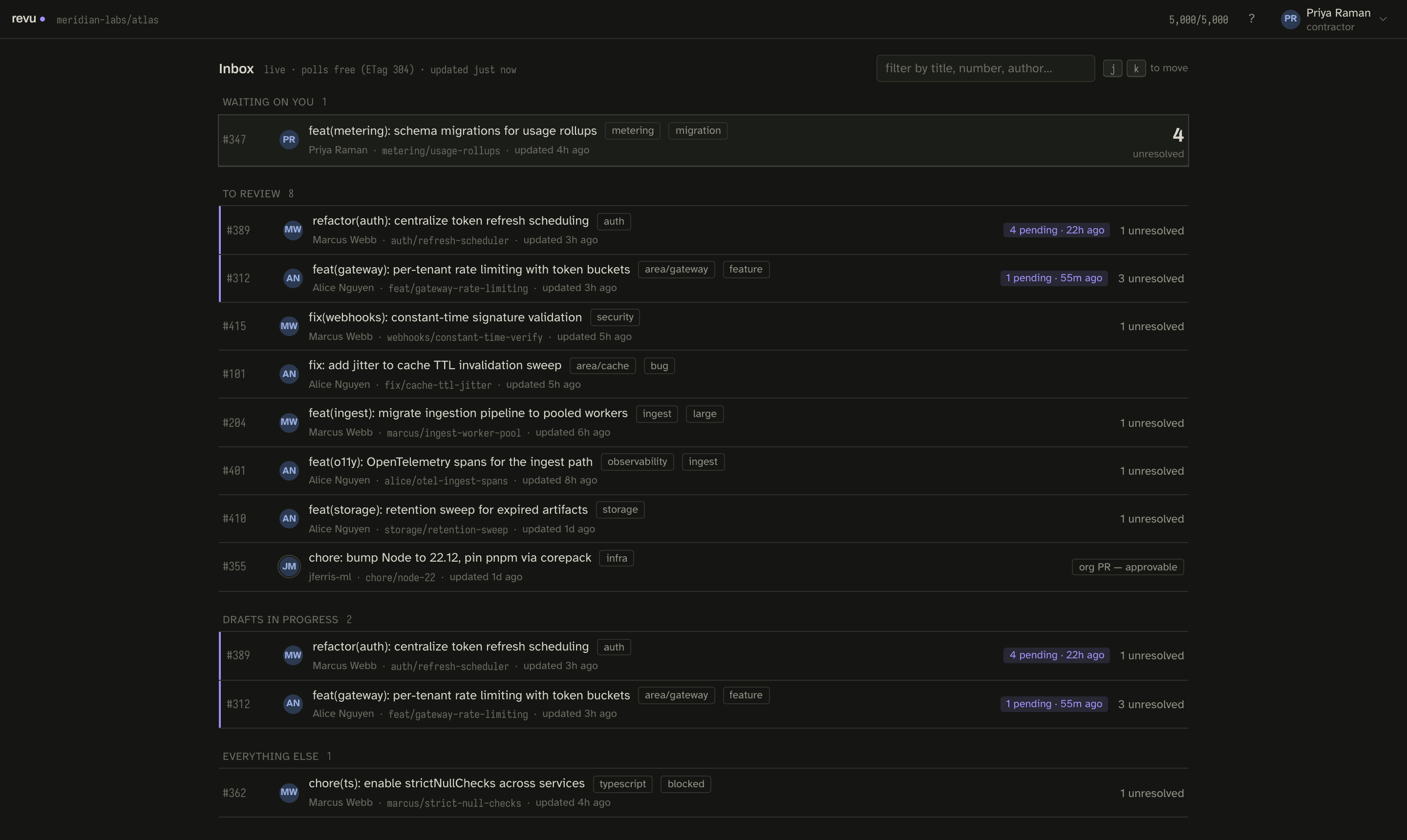
| #101 | First sync — the happy path, with honest request-cost copy. |
| #204 | A 2,400-line diff: virtualization, lockfile + big-file collapse, a binary, a rename. |
| #312 | Mid-review: resolved / outdated threads, a suggestion block, reactions, a deep reply chain, a seeded draft. |
| #347 | You authored it — author banner + walk-the-queue mode. |
| #355 | An org-member PR — the one place Approve actually works. |
| #362 | Failing checks (full log excerpt) + a merge conflict. |
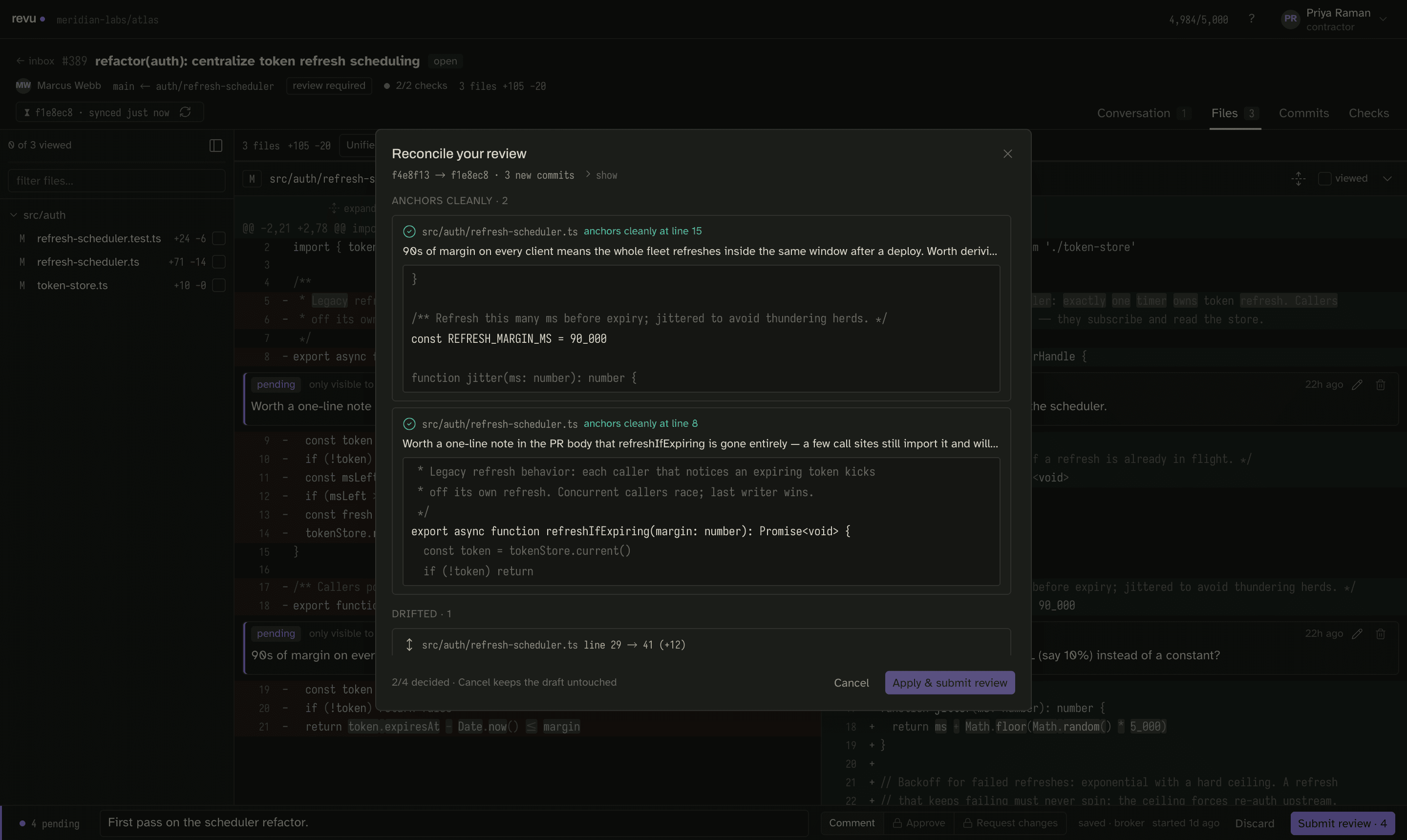
| #389 | Stale snapshot + a draft against an old head → the full reconcile flow (clean / drifted / lost). |
| #401 | A sync that dies partway — a partial snapshot that names what's missing; the retry fetches only that. |
| #410 | The base branch advanced, head didn't — the diff still changed, and the seal says so. |
| #415 | A thread resolved elsewhere since sync, zero new commits — re-sync reuses every blob. |
What each one proves
- #101 — the baseline. A never-synced PR, then a first sync. It is the
reference for a well-formed snapshot:
partialis null, at least one blob is fetched, the immutable half is populated, andgetSnapshoton the un-synced PR reads back asnull, not an error. - #204 — the large diff. 2,400 lines with a virtualized viewer, a collapsed lockfile and big file, a binary that is collapsed rather than fetched, and a rename. It is the proof that a big PR stays cheap because blobs come from the local git store.
- #312 — mid-review. Resolved and outdated threads, a suggestion block,
reactions, a deep reply chain, and a seeded draft — the head-guard target.
Submitting against a wrong head SHA here must return
head_movedas a value and leave the draft untouched. - #347 — you authored it. The author banner and walk-the-queue mode for working through your own PR's unresolved threads.
- #355 — the org-member PR. The one PR the shared identity did not open, so Approve is actually live. Everywhere else it is gated.
- #362 — things are broken. A failing check run with a full log excerpt, plus a merge conflict — because checks and mergeability refetch on every sync, unconditionally.
- #389 — reconcile. A stale snapshot with a pending draft against an old head, three new commits landed. Re-syncing and submitting routes through the full reconcile flow: some comments re-anchor clean, one drifts, one is lost. Nothing is silently discarded.
- #401 — partial sync. The first sync dies mid-burst; revu keeps the partial
it managed to fetch and names the missing blobs. The retry fetches exactly
those and completes with
partial: null. - #410 — the base moved. Head is unchanged but the base branch advanced, so the three-dot diff changed. The compare key moves even though head didn't, and the seal goes gold to say so.
- #415 — resolved elsewhere. A thread was resolved on github.com with zero new commits. A re-sync refetches the mutable half and reuses every blob, because the immutable half is content-addressed and nothing about it changed.
The conformance mapping
Six of these fixtures are the scenarios the cross-transport conformance suite runs against every adapter — the in-process mock and the daemon over HTTP — to prove they honor the identical contract. The suite names each scenario by role; the fixtures fill those roles:
| Scenario | Fixture PR | The invariant it pins |
|---|---|---|
baseline | #101 | A never-synced pull reads back null; a first sync produces a well-formed snapshot that fetches blobs. |
seededDraft | #312 | submitReview against a stale head returns head_moved as a value and leaves the draft untouched. |
baseAdvanced | #410 | Head unchanged but compareKey moved; re-sync rebuilds the immutable half. |
mutableDrift | #415 | The mutable half refetches; re-sync reuses every blob (zero refetched). |
partialSync | #401 | The first sync throws network and keeps a partial; the retry fetches only the missing blobs. |
reconcile | #389 | After re-sync, reconcile yields clean / drifted / lost, and the client-side preview matches the report for every comment. |
Because the assertions live in the shared package and run against both transports, these fixtures are what let anyone touch the sync engine later with confidence. See Architecture for how the suite is wired.
The dev panel
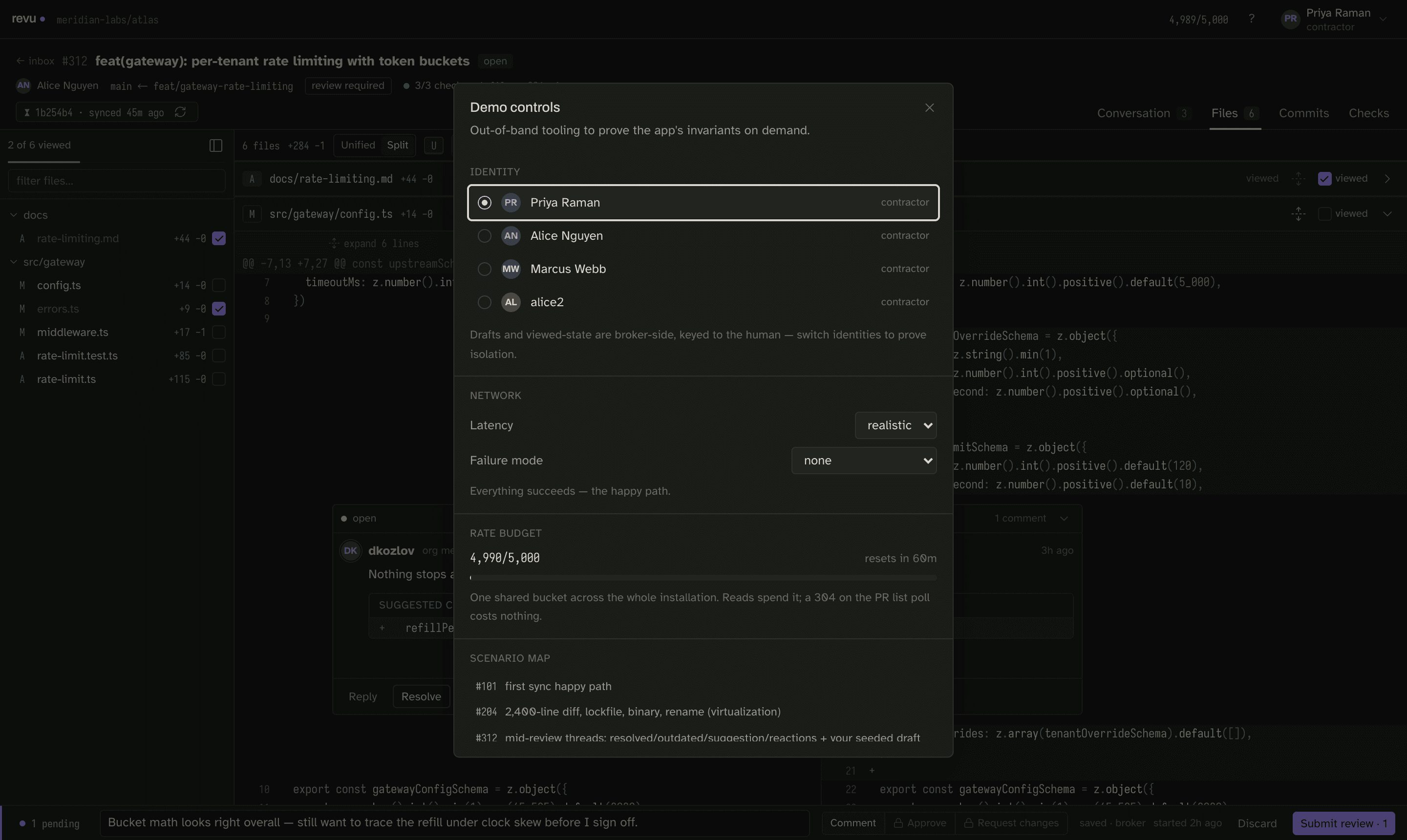
The dev panel (avatar menu → Dev panel…, mock mode only) switches identity between the fictional contractors, simulates latency and failure modes, shows the shared rate budget, and links every scenario above.
Related
- Mock mode — the in-browser demo these fixtures drive.
- Reconcile — the flow #389 walks through.
- Compare key — why #410 and #415 behave differently.